Sculpture Exhibition at San Galgano
The Italian gothic Abbey of San Galgano, formerly a Cistercian monastery, was founded in the valley between the towns of Chiusdino and Monticiano, in the province of Siena. Built between 1224 and 1288, only the ruins of the Abbey are still standing today. The monastery endured numerous pillages in the 14th century, and began to decline in the following century. The church was deconsecrated in 1789, following the failure of the deteriorating bell tower, which fell upon the south arm of the transept of the church, causing heavy damage to the structure below.
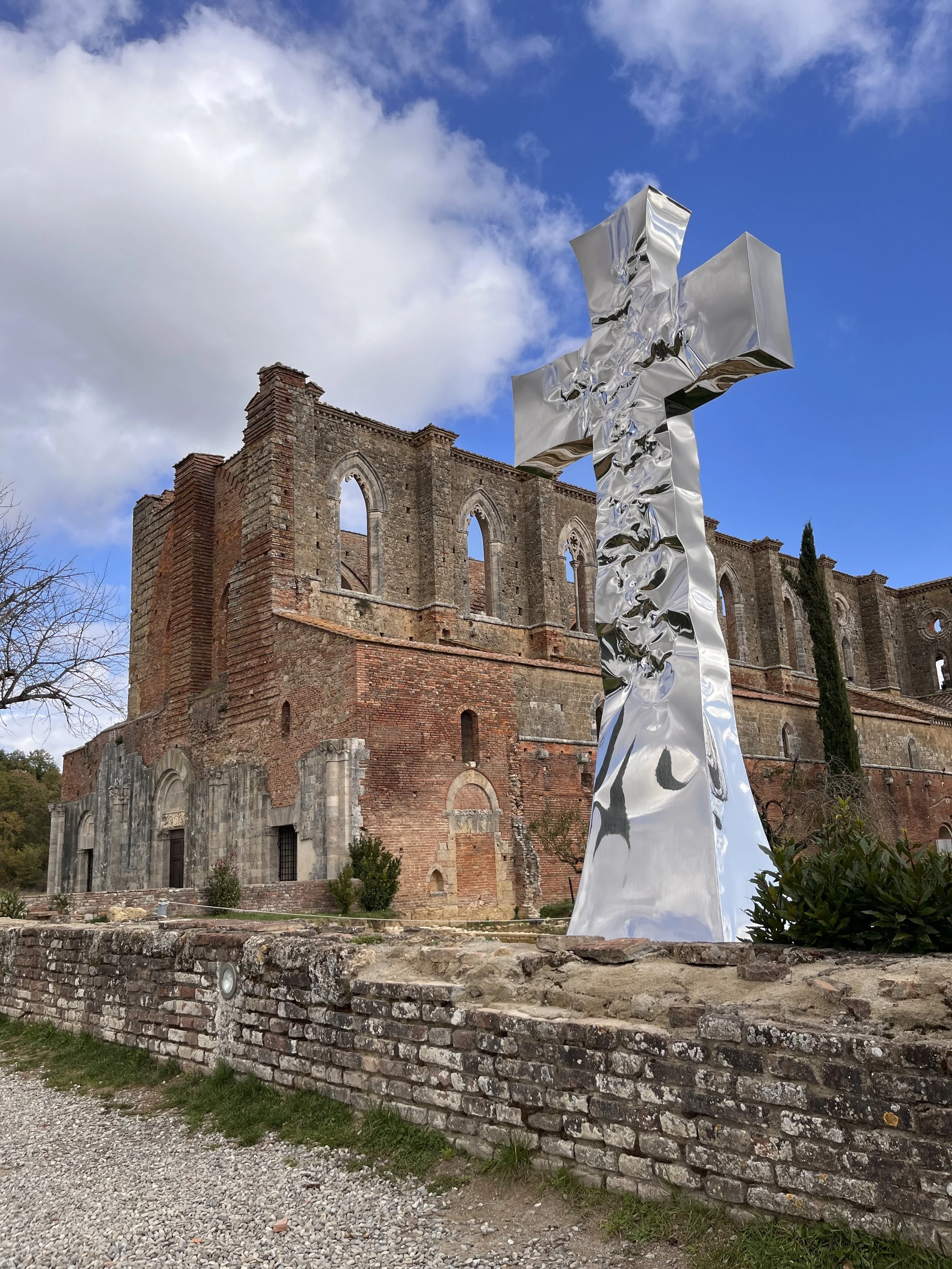
Exterior of the Abbey of San Galgano, Flanked by the 7-Meter High ‘Luce Divine,” a Stainless Steel Cross Designed by Helidon Xhixhi
On Montesiepi, the hill to the North of the ruins of the Abbey, is the site of the former hermitage the nobleman Galgano Giudotti and a present-day chapel. Born in 1148 to a local noble family, Galgano Giudotti became a medieval knight during the 12th century. The story goes that, after he had visions of the Archangel Michael, and the 12 Apostles, he radically changed and began to lead a hermetic life of penitence at Montesiepi. During his stay at Montesiepi, Galgano plunged a sword into the rock on the peak of the hill, as a sign of abandoning his military vocation for the life of a hermit. Legend has it that, one night, while Galgano was away from Montesiepi, three thieves attempted to remove the sword from the rock. One thief was immediately struck by lightening, the second thief drowned, and the third thief was attacked by a wolf. That thief’s arms are in a glass case, covered by a purple cloth, in a reliquary located in a room behind the present-day chapel on Montesiepi. Walk in and lift the cloth, and you’ll see them. Galgano died in 1181. He was canonized a saint in 1185, and was the first saint whose canonization was conducted in accordance with a formal process established by the Church.
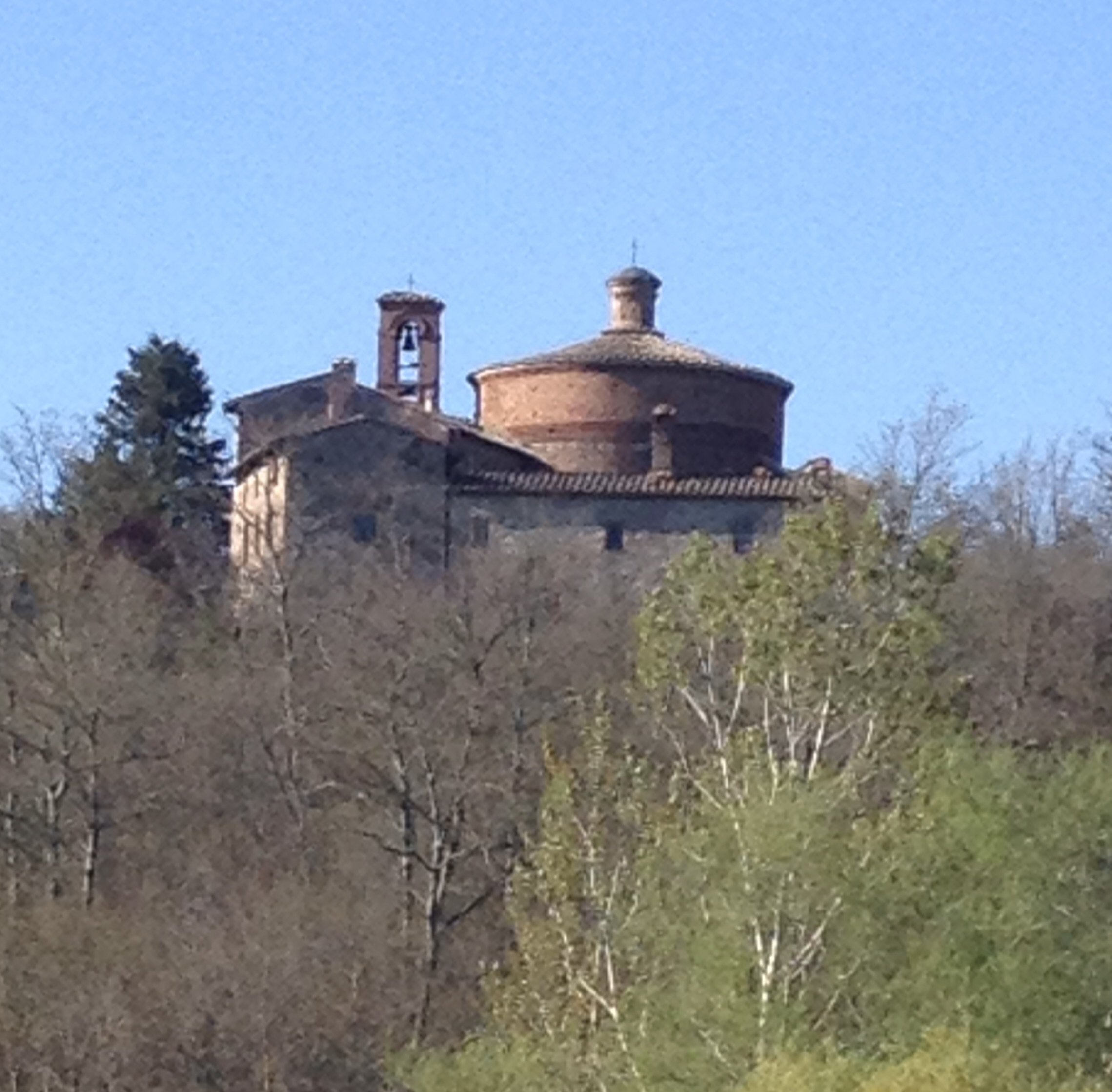
The Rotonda di Monte Siepi
In 1182, construction began on the present-day chapel on the former site of Galgano’s hermitage, known as the Rotonda di Monte Siepi. The form of the chapel is a cylinder, capped by a flat dome. Beneath the center of the dome, on the floor below, you can see Galgano’s sword in the rock.
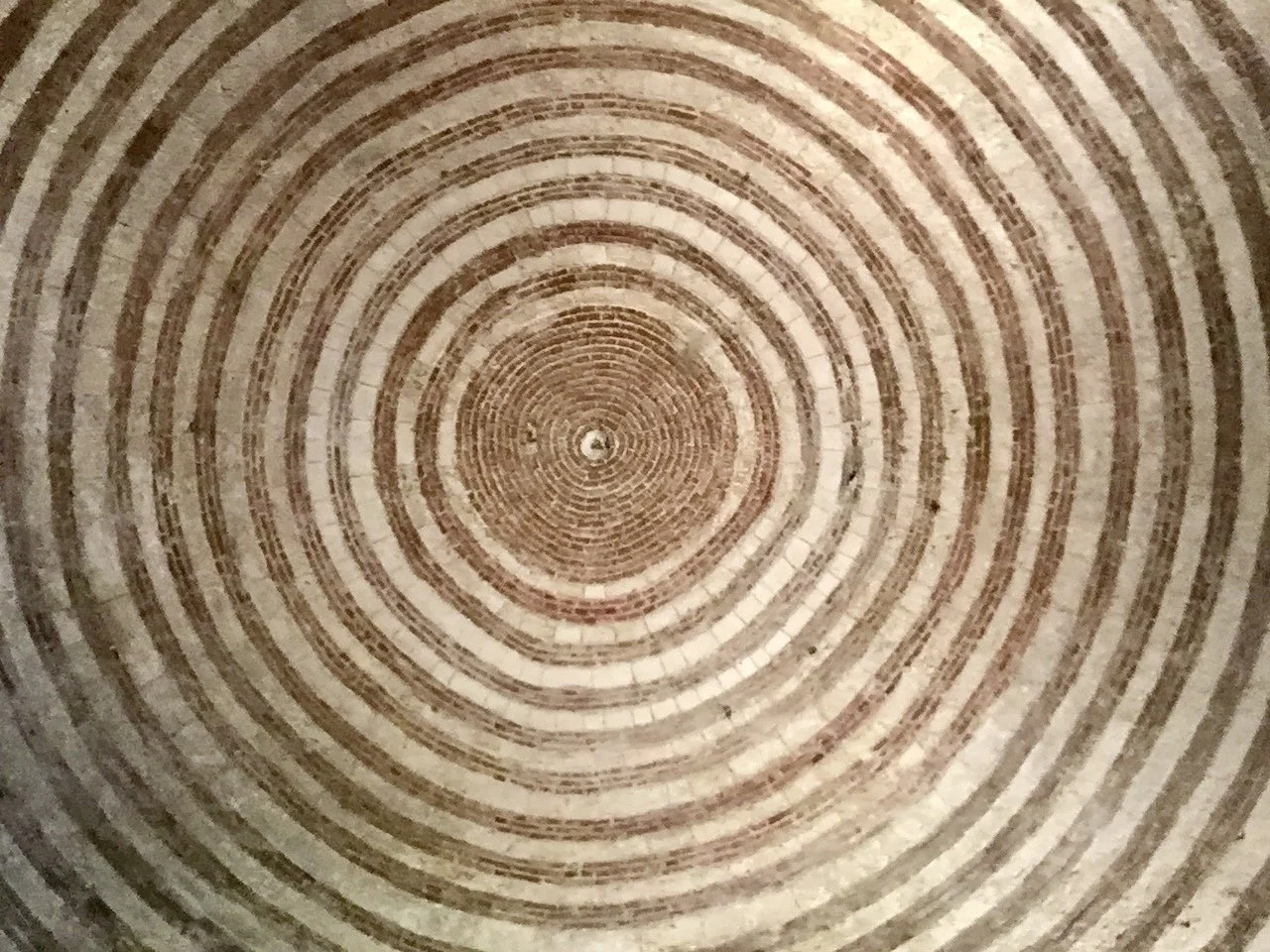
The Dome inside the Rotonda di Monte Siepi
For the occasion of the 2025 Jubilee Year, the Abbey of San Galgano hosted a magnificent exhibition of stainless steel sculptures by Helidon Xhixhi, an Italian-Albanian artist, curated by Carlo Pizzichini. The beauty of the ruins of the Abbey is captured in reflections on the mirror-like surfaces of the sculptures.
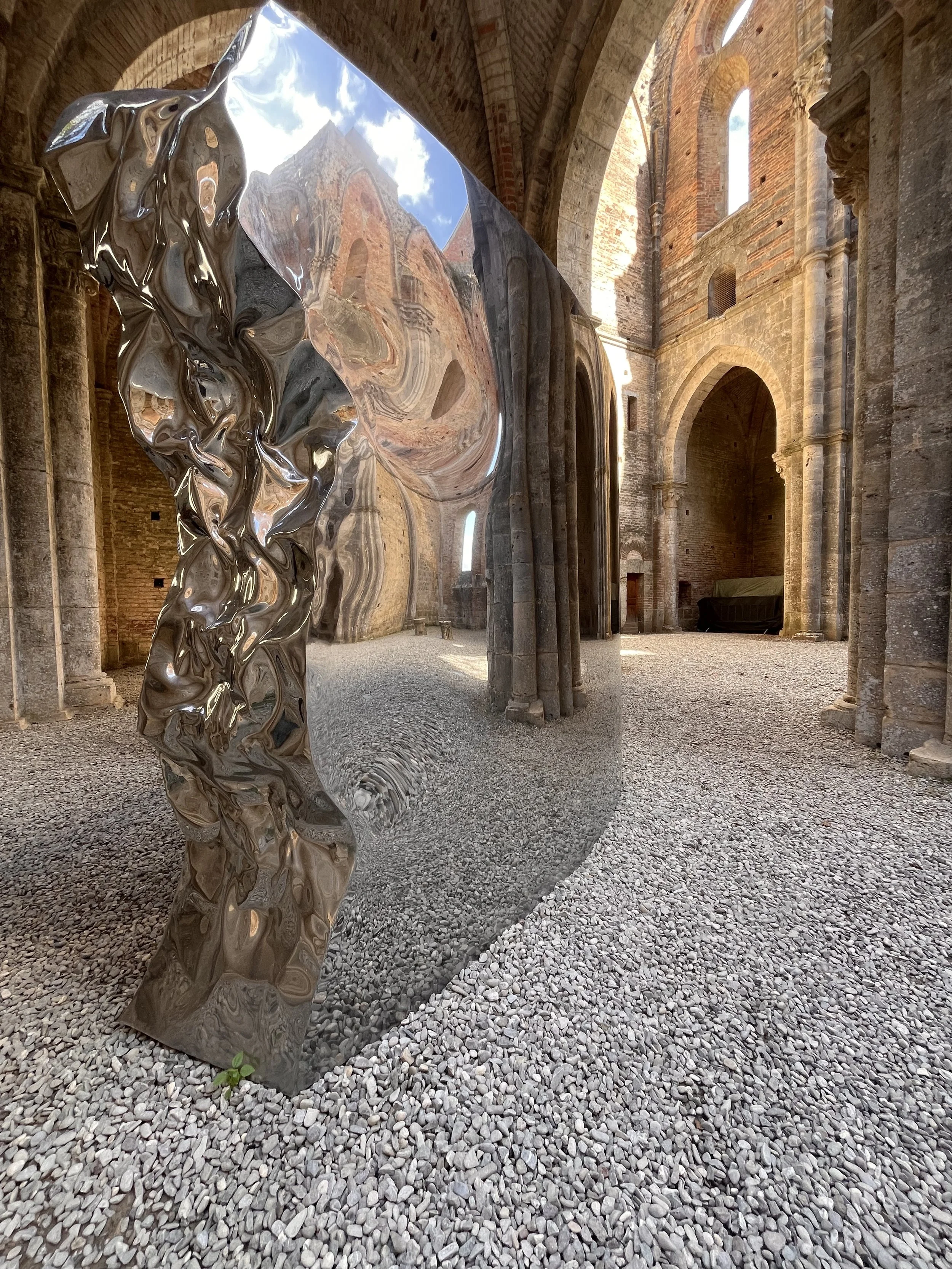
Reflection of the Ruins of the Abbey of San Galgano in ‘Baia di Luce’ by Helidon Xhixhi
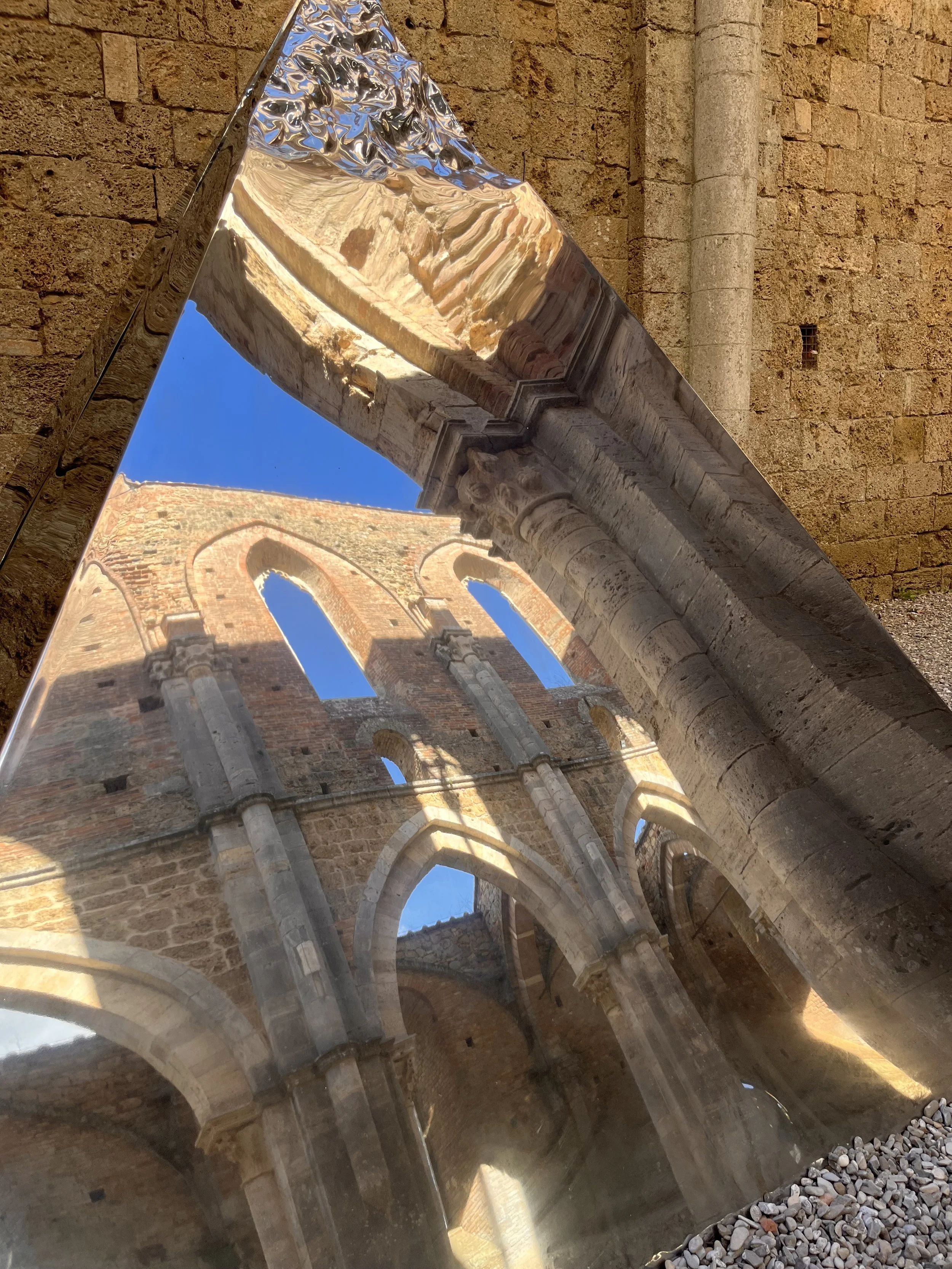
Reflection of the Ruins of the Abbey of San Galgano in ‘Piramide di Luce’ by Helidon Xhixhi
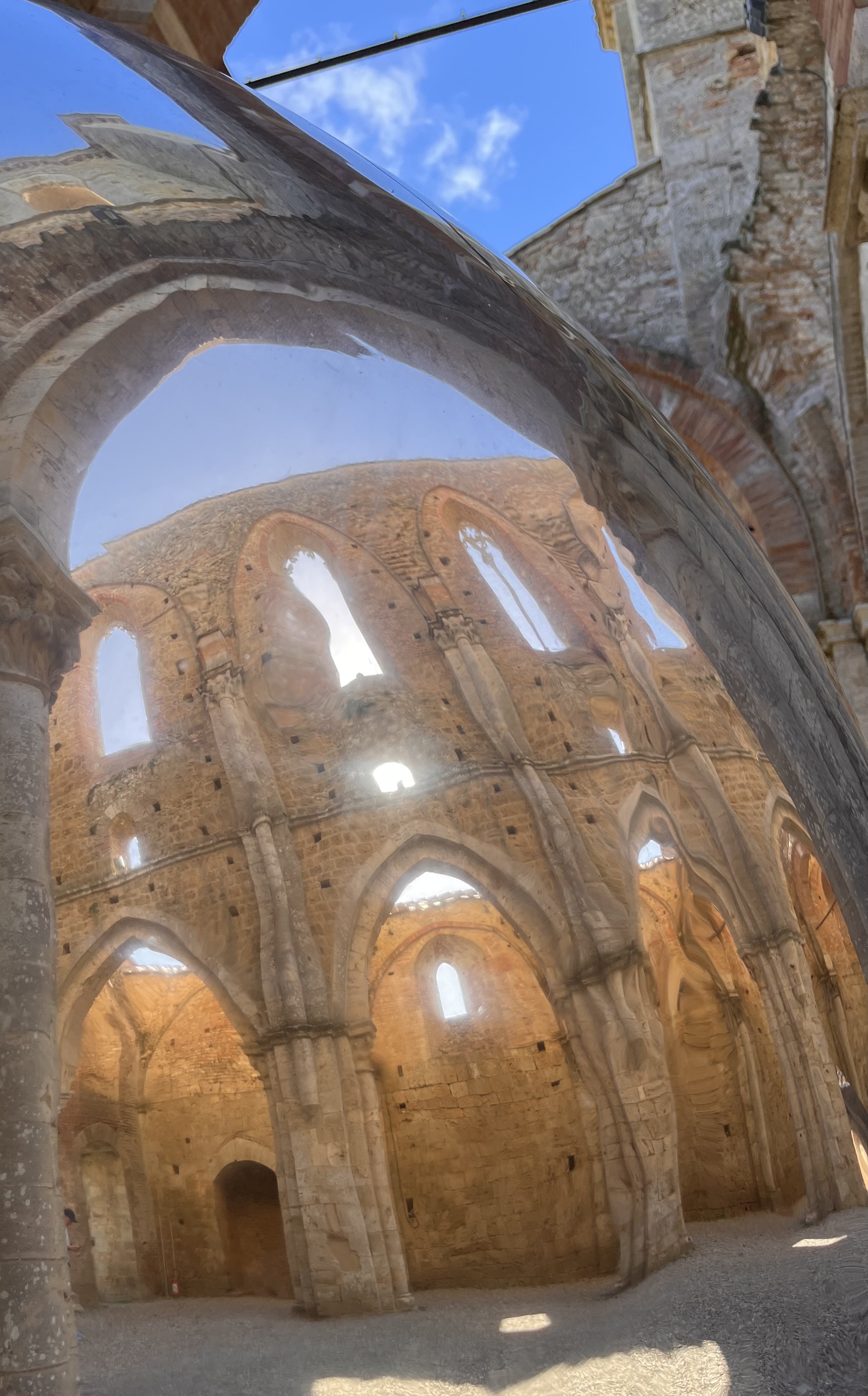
Reflection of the Ruins of the Abbey of San Galgano in ‘Reflexes’ by Helidon Xhixhi
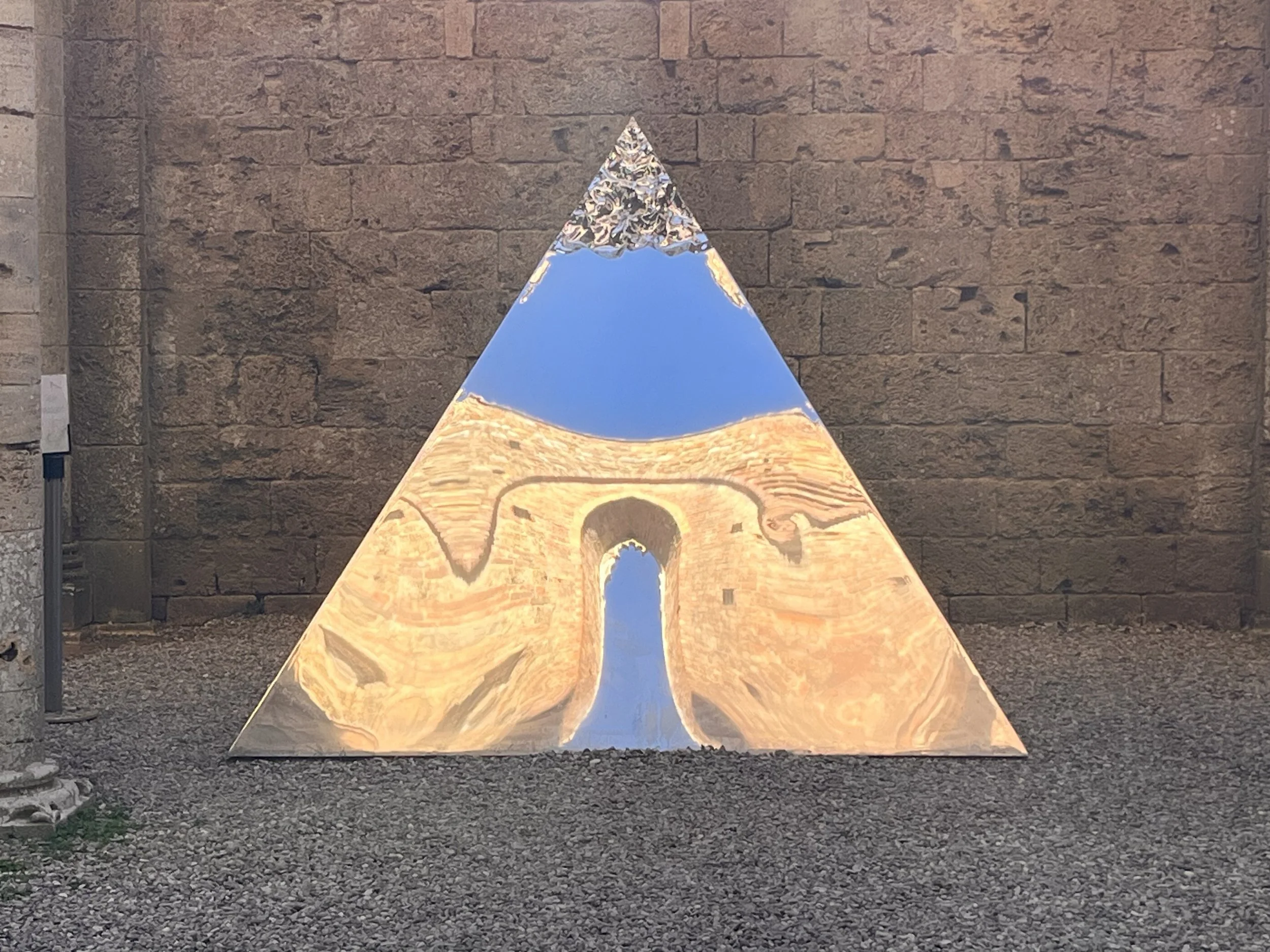
Reflection of the Ruins of the Abbey of San Galgano in ‘Piramide di Luce’ by Helidon Xhixhi
The form of the Rotonda di Monte Siepi and the deconstructive nature of the ruins remind me of one of my favorite recipes — the frittata. Of course, there is no real recipe for a frittata. You just make it from whatever you have on hand. It’s a great way to use (or get rid of) left-over pasta. The other day, a house guest purchased some squash flowers; they were in the refrigerator on their last legs. I chopped the squash flowers coarsely to preserve their color and form, added chopped olives, onions, a little kale lacinato (cavalo nero, in Italian), and threw in a little hot pepper, salt and a generous helping of grated pecorino romano. Then, I mixed in 3 eggs (you add enough eggs so that the mixture is well coated, but not soaking in egg). I didn’t have any left-over pasta; if I did, I probably would have thrown that in as well. Pour the mixture into a frittata pan, put it on top of the stove at medium heat, let it lightly brown on one side, then flip it and leave it until it is lightly browned on the other side. Slide the frittata onto a large plate. Let it rest for about 10 minutes, slice it, and dig in. Creativity is the key — it’s always different, every time you make it — a great way to clean-out the refrigerator.